
Skip to Content

Diagnostics for neural antibodies at Labor Krone

Update of the analyses program

Dear colleagues,

We constantly adjust our diagnostics for neural antibodies to the latest findings and diagnostic possibilities. Hence we update our analyses program as of the 11th February 2019. Please note the following important changes we would like to point out:

Changes to the standard program: Serum VGKC-complex antibodies (RIA) are no longer tested as part of the standard program. Meanwhile there is sufficient evidence that increased VGCK-complex antibodies without demonstration of antibodies against LGI1 and CASPR2 have no clinical relevance in primary diagnosis (further information). However, individual requests are still possible. In addition to the cell-based assay, which is included in the standard program, testing for mGluR1-antibodies is carried out (further information). These changes do not result in a price increase.

Additional information on the request form (Formtype 18): The individual request for classical onconeural antibodies (immunoblot) in the category “Autoimmune encephalitides” is omitted. The test alone is insufficient for this indication and already included in the standard program. Within the section “Polyneuropathy/Immune neuropathy” the classical onconeural antibodies are still available as separate requests. The new test available in our diagnostic spectrum is myositis-specific and myositis-associated antibodies by immunoblot. A detailed list of the parameters included can be found under the indication “Myositis”. Within the category “Polyneuropathy/Immune neuropathy” we also have a screening for paranodal antibodies by tissue-based assay on offer.

Please order your desired quantity of the newest request form (Formtype 18) by e-mail to neuroak@laborkrone.de or by telephone: +49 5222 8076-259. Please do not use the previous form any longer. We are also happy to answer any of your queries about neural antibody requests. Shipping material can be ordered via telephone +49 5222 8076-444.
Diagnostik auf neurale Antikörper im Labor Krone

Aktualisierung des Untersuchungsprogramms

Sehr geehrte Kolleginnen und Kollegen,

wir passen unsere Diagnostik auf neurale Antikörper kontinuierlich den neuesten Erkenntnissen und diagnostischen Möglichkeiten an. Daher aktualisieren wir ab dem 11. Februar 2019 unser Untersuchungsprogramm. Im Folgenden möchten wir kurz die wichtigsten Änderungen vorstellen:

Änderungen im Standardprogramm: VGKC-Komplex-Antikörper im Serum (RIA) werden nicht mehr im Rahmen des Standardprogramms untersucht. Mittlerweile gibt es ausreichend Evidenz, dass erhöhte VGKC-Komplex-Antikörper ohne Nachweis von Antikörpern gegen LGI1 und CASPR2 in der Primärdiagnostik keine klinische Relevanz besitzen (weitere Informationen). Eine Einzelanforderung ist aber weiterhin möglich. Mit dem im Standardprogramm enthaltenen zellbasierten Assay wird nun zusätzlich die Untersuchung von mGluR1-Antikörpern durchgeführt (weitere Informationen). Diese Änderungen haben keine Preiserhöhung zur Folge.

Ergänzungen auf dem Anforderungsschein (Belegtyp 18): Die Einzelanforderung klassischer onkoneuralerAntikörper (Immunblot) in der Rubrik »Autoimmunenzephalitiden« entfällt. Sie ist unter dieser Indikation allein nicht ausreichend und bereits im Standardprogramm enthalten. Unter »Polyneuropathie/Immunneuropathie« stehen die klassischen onkoneuralen Antikörper weiterhin als separate Anforderung zur Verfügung. Neu in unserem diagnostischen Angebot ist die Untersuchung auf Myositis-spezifische und -assoziierte Antikörper im Immunblot. Eine Auflistung der enthaltenen Parameter finden Sie unter der Indikation »Myositis«. In der Rubrik »Polyneuropathie/Immunneuropathie« bieten wir zudem ein Screening auf paranodale Antikörper mittels gewebebasiertem Assay an.

Bestellen Sie den aktuellen Anforderungsschein (Belegtyp 18) unter Angabe der gewünschten Stückzahl per E-Mail an neuroak@laborkrone.de oder telefonisch: 05222 8076-259. Bitte verwenden Sie die ältere Version nicht mehr. Gerne beantworten wir hier auch Ihre Fragen rund um die Anforderung der neuralen Antikörper. Versandmaterial kann über die Telefonnummer 05222 8076-444 bestellt werden.

Regional resistance situation of gonococcus

According to current data of the WHO, gonorrhea is the third most common sexually transmitted infection (STI) worldwide.  Unfortunately, there is no reliable epidemiological data from Germany as gonococcus infections do not fall under the mandatory reporting obligation. In addition to this, a global increase in resistance is observed. For the collection of valid data regarding the resistance situation in Germany, in 2013, project GORENET, in which Labor Krone takes part, was established.

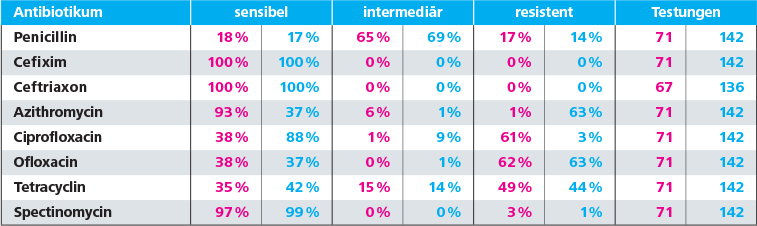
In view of the resistance situation in our region, we can follow the recommendations of the S2k-guidelines for empiric therapy: In our submissions, sensitivity for ceftriaxone is at 100 % (OWL alone at 100 %) and azithromycin at 88 % (OWL alone at 93 %). It should be noted, that administration of azithromycin in the empiric treatment rather aims at the co-infection with chlamydia.

An alternative ciprofloxacin therapy should only be used after previous testing, as the current resistance situation is insufficient for empiric treatment. The exact resistance situation is listed in the table below.

Conclusion: The guideline-oriented empiric therapy with ceftriaxone and azithromycin is recommended for this region. Prior to therapy commencement, swab diagnostics for gonococcus-PCR and gonococcus cultures (CAUTION: different swab kits!) should be carried out. Pathogen demonstration by PCR is more sensitive than a culture; however, resistance testing is only possible for culture-bred pathogens. Therapy monitoring can be in consideration of clinical aspects, if necessary, a swab for gonococcus culture 3 – 7 days after the end of therapy can be taken. Testing via PCR only makes sense a minimum of 2 weeks after the end of treatment, as otherwise avital pathogens could be detected. Partners should also be treated!

Regional resistance situation of gonococcus

Resistances for Neisseria gonorrhoeae in OWL, or total number of returns from Labor Krone, period: 01.01.16 – 31.12.2018

Please do not hesitate to contact us if you have any further questions.

Department of microbiology

Dr. med. Patricia Wehmeier, Dipl.-Biol. Andreas Groß, telephone +49 5222 8076-0